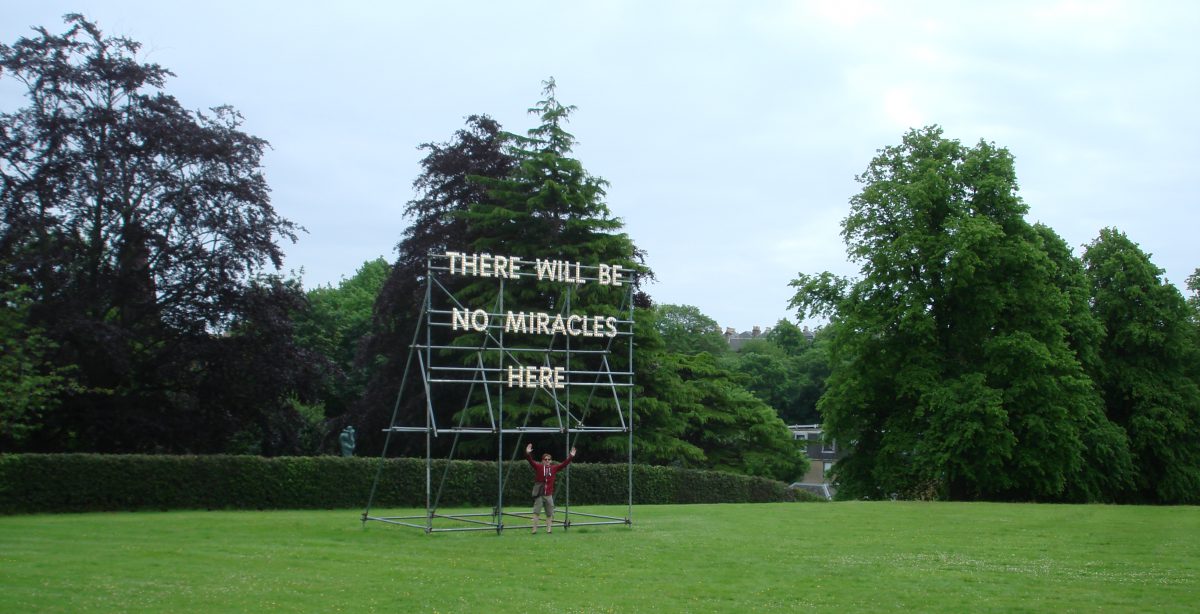
According to the website of the National Galleries of Scotland, the prominent sculpture in front of the Scottish National Gallery of Modern Art Two, There Will Be No Miracles Here, from Nathan Coley, can be quickly described and explained as follows:
This outdoor work by Nathan Coley proposes, on a scaffolding support six metres high in illuminated text, ‘There Will Be No Miracles Here’. This originates from a project in which Coley posted a series of public announcements around the town of Stirling. One included these words, taken from a seventeenth-century royal proclamation made in a French town believed to have been the frequent site of miracles. Coley’s practice is based in an interest in public space, and how systems of personal, social, religious and political belief structure our towns and cities, and thereby ourselves.
For me the appearance of this magnificently bold sculpture as one approaches the Scottish National Gallery of Modern Art Two is, despite itself, virtually ‘miraculous’ in its appearance, and in its proclamation. I delight in visiting and revisiting it, and looking at it from a variety of angles and distances, even as it seems remarkably simple in terms of its constituent parts and how they are arranged as a whole. I like the message, too–to me it suggests that what is and will be offered is partial and limited, and will inevitably be superseded, at least eventually, but that does not mean it is other than worthwhile. To the contrary–it is honest about what it is, and what it is not, about what it can be and what it cannot be. It suggests doing and offering what is possible, including what might seem impossible, from within the present configuration of what is recognized as actually existing and realistically possible–but that it won’t be more than that, more that what is possible. How to determine the limits of the possible, without inordinately confining and constraining what might yet be but what is not yet, while also not pushing for that which cannot be, at least not according to the terms expected or demanded of it, at a particular conjuncture?
In this blog I don't pretend to offer more than my own observations and reflections, based upon whom I am, where I come from, and what I am about. These may be of interest–and use–to others, and then again they may not. I don't promise miracles. I have my limitations, and they are many; I won't pretend otherwise–I promise not to do so. I promise to be open, honest, forthright, committed, caring, concerned, compassionate, and empathetic. I trust that these are strengths of mine as throughout my life I have been commended the most often, repeatedly, by many diverse people, again and again, for these qualities. I do think I have insights worth sharing, it strikes me so whenever I recount stories to my students of my own life-experiences, and I am unsure how much longer I will have the opportunity to do so. Most of my life has been overwhelmingly dedicated to teaching, and working exceedingly closely with students, so much so I often have extremely little time, or energy, left for as much else as I would ideally like. And I also have spent most of my adult life dealing with serious chronic illnesses, invisible disabilities, and mental health challenges that have likewise considerably limited how much and how far I can extend myself, even though I try to do as much of this as I can. I know it can be extremely difficult to say that one really ‘knows' another person, but sometimes I worry my students, and a few other close friends, are the only ones who really have ever got to know me well. Why does that matter? Well, simply because I do believe I am worth knowing, and those who have got to know me always seem to think so.
I think one of the best possible ways to begin is to share the latest version of a final examination assignment I have been giving to my English 284, Introduction to Theory and Criticism classes, every since the Spring 2005 semester. It is a great assignment; students respond with impressively powerful and moving responses, which makes me appreciate them all the more than I already do, and to be honest I love my students. In this assignment I ask students to prepare five minutes' worth of responses to any one or more of the following sets of questions to share, orally, with the rest of the class:
1.) What do you (truly) value? What (really) matters to you? Why?
2.) Where are you coming from in relation to what you, today, strongly value? How have these values developed and changed over the course of your life to date?
3.) What do you aspire to be and do in your life ahead? Why is this important–to you? What would you like to accomplish and to contribute, in your life ahead, thinking about this from where you are at here and now? Why is this important–to you?
The full assignment itself is much longer as I provide a substantial context for making sense of what we are doing, and why, while also sharing much of how I myself would address these questions. For those reasons, I think sharing the entire assignment here will prove an apt beginning for this blog.
**********
English 284-002: Introduction to Theory and Criticism
Spring 2018, UWEC, Professor Bob Nowlan
Final Examination Assignment
For Tuesday May 15, 8 to 9:50 am, Centennial 4308
In the “extended explanation” section I include near the beginning of our class syllabus I write the following:
Throughout the everyday lives of each and every one of us, our ability to make sense of the world around us–and to orient ourselves to engage in relation to it on the basis of how we make sense–means we are continually working with “theories” of one kind or another. At the same time, because our everyday lives also demand we make numerous judgements according to various standards and criteria and we then proceed according to the judgements we have made, we are also continually thinking and acting in ways which are at least rudimentarily “critical” as well. Nevertheless, in our everyday lives most of us do not all that often reflect upon precisely what theories are guiding and sustaining us, how so, and why so, nor do we frequently examine how and why we think and act critically in the ways that we do. Moreover, if asked to produce a rigorous intellectual explanation, precisely accounting for and meticulously justifying the theoretical and critical influences upon and determinants of our everyday ways of thinking, understanding, feeling, believing, interacting, communicating, acting, and behaving, most of us would have a very difficult time.
Because the theories that guide and sustain us and the ways in which we think and act critically in our everyday lives are rarely simply the result of our own uniquely individual creation and rarely a matter simply of our own autonomously free choice–especially when we either are not conscious of their effects upon us or are unable to explain, account for, and justify these in a sustained and rigorous fashion–we are always working according to the influence and the determination of theoretical and critical approaches which are much larger than the space “inside” of our own “heads” or “minds”: we are always working according to theoretical and critical approaches which occupy particular places within particular societies and cultures and which are formed as particular products of particular histories and politics.
A course of “introduction to theory and criticism” presents an opportunity not only, therefore, to learn about the theoretical and critical approaches of what might often at least initially seem like an elite caste of distant and specialized others–specific, and frequently famous, named “theorists” and “critics”–but also to reflect upon how and why all of us work with the kinds of theoretical and critical approaches we do; where these come from and what gives rise to them; where they lead and what follows from them; which such approaches predominate in what areas of everyday life today, in what places within what societies and cultures, with what uses and effects, toward the advancement of what ends and toward the service of what interests; and what alternative approaches are possible, what alternatives are desirable, what alternatives are necessary, and how do we get from here to there.
Throughout this past semester, we have studied key positions, concepts, and arguments as well representative primary texts from nine directions in critical theory that have exerted an especially prominent influence over, and impact within, recent and contemporary English (Literary and Cultural) Studies. This engagement invites and encourages you to reflect on how you yourself understand a host of major issues, and why so: issues of reading, writing, meaning, language, knowledge, understanding, expression, communication, textuality, identity, difference, psychology, literature, culture, history, economics, politics, religion, spirituality, class, race, gender, sexuality, ethnicity, nationality, and more. As I explain in the statement from our syllabus cited above, everyone works with theories, and modes of criticism, all the time, most often with little conscious reflection on which ones, or why these particular ones. Studying theory and criticism offers you the opportunity to begin to reflect on these matters, by considering where you are at, where you are coming from, what you are about, and where you are headed, in connection with the theories and modes of criticism–the particular principles, values, ideals, commitments, understandings, and ways of thinking, feeling, believing, acting, interacting, and behaving–that have played and do play an especially prominent role in shaping who you are and that are especially influential in affecting your outlook upon and your engagement with your self, with others, and with the larger world. Developing the habit of mind, and, even more than that, the ethical commitment, to engage in the world, theoretically and critically, is ultimately what is of greatest importance, in relation to what you take from this course–as opposed to any specific critical and theoretical ideas, however useful and of interest many of these may well be.
In the final examination assignment, you will share with us, orally, a MAXIMUM of five minutes’ worth articulation of your own–individual–thoughts in response to one or more of the following sets of questions:
1.) What do you (truly) value? What (really) matters to you? Why?
2.) Where are you coming from in relation to what you, today, strongly value? How have these values developed and changed over the course of your life to date?
3.) What do you aspire to be and do in your life ahead? Why is this important–to you? What would you like to accomplish and to contribute, in your life ahead, thinking about this from where you are at here and now? Why is this important–to you?
Please prepare a typed version of what you will present in class to give me at the end of this final examination class meeting (although you may feel free to speak off of and away from this written text as you need or want to do when sharing your response in class).
In responding to this assignment, you may focus your answer on any one or more of these specific sets of questions; again, you do not need address them all. And this certainly does not have to be the only possible way you could answer these, even right now, although your answers should be thoughtful, serious, and genuinely meaningful to you. This assignment, moreover, only asks you to answer (some of) these questions as you are inclined to do so at present; of course, you likely will answer them differently in the future, and you likely would have answered them differently in the past.
Also, I will not interpret these questions for you, or specify a particular way “I want you to answer them”–or even “what I am looking for” in how you address them, other than asking you to take an approximate average of five minutes to address them, and to do so honestly and sincerely.
And I do mean honestly and sincerely here; one of the conventions of many classrooms, including at the college level, and in many kinds of courses, is to put people in situations where they are virtually always pretending, virtually always playing, virtually always voicing or acting what they have no necessary stake in and what could just as easily be a position that they entirely disagree with and that they’re just trying out, or trying on, for aesthetic–or libidinal–effect. (In short you are not to ‘play the devil’s advocate’ here; not only is this ultimately self-protective in a way that runs counter to the aim of this assignment, but also students regularly purporting to do this has become a clichèd way of engaging with far too many assignments.) It’s all too easy for engagement with every course, and every class, to become just another game, just another way of going through the motions, just another place where nothing really important ever is expressed or exchanged–and where we all, always, protect ourselves from ever actually taking the risk of committing ourselves to anything of substance, or anything that entails any kind or degree of risk. That’s not the aim here; on the contrary, we are aiming for the opposite.
In the past students have greatly appreciated working on this assignment and found the experience of sharing these statements with the rest of us highly interesting and highly valuable. I hope you will too. Your grade for this assignment will be worth 15% of the overall course grade.
***
Many ways of responding to an assignment like this one are possible. I don’t expect anyone to look to me as a model. I understand, appreciate, and respect students will maintain many considerably different positions, and perspectives, than my own. However, just to give you some spark toward thinking about how you might address this assignment yourself, I am going to share, below, some writings of my own related to the questions I ask you to consider. I do so as well simply to be open, honest, and forthcoming with you about who I am, where I am coming from, and what I am about; it is important I do so, and be so accountable, if I want you to share with me, and each other, what I am asking you to share in this final examination assignment.
To begin I will share a statement I composed, titled “What Progressives Believe,” which I prepared a number of years ago as a guiding set of principles–and, especially, values–to enable the activities of multiple organizations I have been involved with locally, from the Eau Claire Progressive Film Festival to WHYS Community Radio to the Progressive Media Network to Progressive Outpost (and more):
1. Progressives believe that we are all ultimately deeply interconnected, that the public good should always come before private gain, that we should work together to take care of each other, that we should work together to make a better future for those who come after us, and that we have a responsibility to do so for those who will succeed us.
2. Progressives believe we maintain a responsibility to serve as genuine stewards in relation to our larger natural environment while progressives at the same time respect and value the ‘wisdom’ of nature as well as all the ‘wisdom’ of what nature has created and provided.
3. Progressives respect and value the wisdom of genuinely popular, or folk, cultures, subcultures, and their customs and traditions as well as their achievements and contributions; progressives support and defend the right of the oppressed and exploited to fight back against their exploiters and oppressors; and progressives seek to assist the relatively disprivileged and disempowered in raising themselves up through their own efforts.
4. Progressives believe in genuine, substantive, materially concrete expression of fairness and equality for all, and progressives sincerely, actively care for those who are relatively disprivileged and disempowered.
5. Progressives believe in working actively to overcome exploitative and oppressive disparities in social wealth, social privilege, and social power.
6. Progressives believe in the inherent dignity, worth, and natural equality of all people, regardless of race, ethnicity, or nationality.
7. Progressives believe in the inherent dignity, worth, and natural equality of all people, regardless of sex or gender.
8. Progressives believe in the inherent dignity, worth, and natural equality of all people, regardless of sexual orientation.
9. Progressives believe in the inherent dignity, worth, and natural equality of all people, regardless of age or of physical and mental ability.
10. Progressives respect and value the contribution of labor, and of laborers, in producing and reproducing social wealth; progressives reject, oppose, and seek to overcome exploitative and oppressive forms of class difference, and hierarchy, especially that realized through the exploitation of labor, and the private ownership and control of the means, processes, and ends of social wealth; and progressives are ultimately, in essence, anti-capitalist and pro-socialist as well as pro-communist.
11. Progressives believe in social responsibility and accountability–and especially in holding those who exploit, and oppress, as well as those who maintain complicity with exploitation and oppression responsible, and accountable, for this wrong, while progressives simultaneously believe in active civic participation, in citizens taking responsibility for our own government, for governing ourselves, and for making government truly the people’s servant and truly serve the people’s interest.
12. Progressives believe that genuine community requires that everyone within the community enjoy the freedom to realize their full human potential, and progressives believe that realization of our full human potential as members of a genuine community is in fact only possible for each and every one of us when freedoms can actually be exercised and opportunities are in fact available.
13. Progressives fight against social alienation, and especially against the forces and conditions which generate this alienation, while progressives at the same time reject, oppose, and seek to overcome cynicism, apathy, disengagement, and despair.
14. Progressives reject, oppose, and seek to overcome selfish individualism, and progressives reject, oppose, and seek to overcome the commercial cooptation of human culture and the commoditization of human social relations.
15. Progressives reject, oppose, and seek to overcome reification and compartmentalization in thought and action, and progressives likewise reject, oppose, and seek to overcome desensitization, callous indifference and lack of concern for others, as well as processes of ‘othering', and especially ‘abjectification’, in general.
16. Progressives strongly oppose militarism and imperialism– economic, political, and cultural.
17. Progressives strongly oppose fascism, neo-fascism, proto-fascism, and post-fascism, in all varieties, as well as all other forms of genuine totalitarianism.
18. Progressives commit themselves toward working actively to advance the causes of human emancipation, collective equality, social justice, ecological sustainability, and a peaceful world.
19. Progressives believe that real social progress ultimately requires real social transformation–and not mere social reformation.
20. Progressives believe in the value, and indeed necessity, of forceful, creative, determined, persistent, and even at times relentless engagement in questioning, challenging, critiquing, resisting, rebelling, and revolting versus established power and authority in order to advance progressive ends and serve progressive interests.
As I’ve indicated previously in elaborating on this list, these are values to which continually to aspire; no one will fully measure up to any of them, not by a long shot, not even in conscientiously aiming to do so. I certainly fall short, even way short, again and again, despite by best efforts to aim to live these values. But these values can prove useful in reflecting critically upon where we are at, and upon where we need to go and what we need to do from where we are at. It requires ongoing work, and struggle, to do the best possible to represent these values, in practice, even partially, even limitedly, and even in very ‘small’ ways (ways that, nevertheless, are not necessarily inconsequential). Nothing any individual does by themself to represent these values ultimately matters anywhere near as much as what many people do together, but what individuals do, even all by themselves, can still matter, as a contribution–however ‘small’– toward a greater collective effort.
***
Next, I will share that Unitarian Universalists (of which I am one) agree upon the following seven principles:
1. The inherent worth and dignity of every person;
2. Justice, equity and compassion in human relations;
3. Acceptance of one another and encouragement to spiritual growth in our congregations;
4. A free and responsible search for truth and meaning;
5. The right of conscience and the use of the democratic process within our congregations and in society at large;
6. The goal of world community with peace, liberty, and justice for all; and
7. Respect for the interdependent web of all existence of which we are a part.
What’s more, as we frequently say, in our congregation, ‘love is the spirit of this church, and service is its law’–i.e., we are committed toward striving to lead our lives guided, everywhere, by love, to foster love throughout human social relations, and to do so at the same time cognizant of a persistent responsibility to serve others, to serve our communities, and to serve the well-being of the world in which we live and which gives us so much. Although you may well maintain exceedingly different kinds of religious/spiritual convictions, or none at all for that matter, this list might also be useful just to give you something to think about, to work off of, in trying to identify a short statement of something particularly meaningful and/or valuable, as you see it.
***
Continuing on to another example of ‘what matters to me’, in recent years I have become deeply concerned about declining political support for the value of public education, and in particular for public higher education. Given the fact the public now only pays for approximately 15 to 20% of the total cost of ‘public higher education’ in this state, it is, moreover, questionable it should continue to be referred to as ‘public higher education’ at all. During my 21 years at UWEC, we have faced cut after cut, while the percentage of our budget paid by student tuition and fees versus state funding has dramatically increased. Students today pay significantly more for less. Our total staff on this campus is 20% less in size than it was just over two years ago. We simply cannot do as much as we used to do, and as much as we want to do, _for you_. I know I have worn myself out by striving to do more than I could, and have had, however reluctantly, to cut back significantly. Throughout the UW system major and minor programs (as well as individual courses and other educational experiences) are continually being cut, even substantially, and that trend seems only likely to continue, if not accelerate. At UW-Superior and more recently UW-Stevens Point, local administrations have proposed eliminating a sweeping array of major programs, including to a significant extent in the arts and humanities. I worry the trends I have just mentioned are being accompanied, on a much larger, national scale, by a de-valuing of the liberal arts, and especially the humanities and the arts, as areas ‘no longer worthy of significant investment’. Our mission statement at UWEC declares: “We foster in one another creativity, critical insight, empathy and intellectual courage, the hallmarks of a transformative liberal education and the foundation for active citizenship and lifelong inquiry.” We can’t make any serious contribution toward realizing this mission if we do not take seriously, and maintain genuine respect for, work in the arts and humanities; this has to be a substantial, materially real commitment, and not just lip service. At the same time, the intellectual, ethical, and professional responsibility of professors has, historically, long been to commit ourselves, first and last, fearlessly, to ‘the search for truth’, whatever this might mean and wherever this might lead, in our particular fields of expertise, regardless of what might be otherwise immediately or widely popular–or practical–and that responsibility is being significantly de-valued as well. I value the kind of work I and my colleagues do, and I certainly admire my courageous junior colleagues, but I think the relative societal value of this kind of work has dropped precipitously since I first seriously considered the prospect of pursuing a career as a professor. Submit, conform, and obey–that is increasingly what is expected of us all, in all that we do. And that is deeply concerning, on multiple levels. ‘The Wisconsin Idea’ is, and has been, multi-faceted, but one key dimension, from the beginning, has been to welcome, invite, and encourage University of Wisconsin faculty to contribute, on the basis of our expertise, significantly and continuously to social service, community welfare, the public good, and even to local, county, and state governance. Today, it often seems like this contribution is, on the one hand, not welcome, invited, or encouraged –and, on the other hand, ignored, dismissed, and disparaged. Moreover, I think pursuing a career as a teacher, or as a professor, is admirable, and should be applauded, but I worry the disincentives for doing so are growing all the more huge–and that our state, and our nation, will suffer seriously damaging long-term consequences as a result. It is quite possible in the not too distant future the prospect of pursuing graduate degrees will be largely unaffordable for people coming from socio-economic backgrounds like mine, and that fewer people will be able and willing to devote the amount of time, energy, effort, care, and indeed money it takes to be a teacher, and especially an effective teacher, on any level. Routinely, for 33 years I have spent multiple thousands of dollars, up to 10 to 15 thousand dollars every year, on teaching and professional development expenses, uncompensated, out of my own salary, but at least I did not need pay taxes on so doing. But that seems likely to change dramatically, and soon. Our state and our nation will suffer severely if this turns out to be the case.
***
Yet further, I believe we face dangerous fascist tendencies within our nation today. We addressed this head-on throughout my Spring 2017 English 359 class, Studies in British Literature After 1790–Dystopian Imaginings Since Orwell’s Nineteen Eighty-Four. For here and now, however, I will only point to two quick summaries of ‘fascist’ tendencies that have proven highly influential, which I shared with my English 359 class, right at the start of our work together. In 2003, Lawrence W. Britt published a brief article, in Free Inquiry, that rapidly became a meme, identifying 14 characteristics of fascist (and, implicitly also, proto-fascist) societies: 1. Powerful and continuing nationalism; 2. Disdain for the recognition of human rights; 3. Identification of enemies and scapegoats as a unifying cause; 4. Supremacy of the military; 5. Rampant sexism; 6. Controlled mass media; 7. Obsession with national security; 8. Religion and government are interrelated; 9. Corporate power is protected; 10. Labor power is suppressed; 11. Disdain for intellectuals and the arts; 12. Obsession with crime and punishment; 13. Rampant cronyism and corruption, and 14. Fraudulent elections. (For more detail, see: https://www.secularhumanism.org/index.php/articles/2710.) Earlier, in 1995, Umberto Eco identified a similar list of 14 characteristics of fascist societies (including, again, also implicitly, proto-fascist societies) in The New York Review of Books (Eco referred to a collective fascist mode, past and present, as ‘Ur-Fascism’, or ‘Eternal Fascism’): 1. The cult of tradition; 2. Rejection of modernism (or the modern) in favor of traditionalism (or tradition); 3. An irrationalist cult of action for action’s sake and a concomitant scorn for intellectuals and intellectual culture (especially for careful deliberation prior to and guiding of action); 4. Intolerance for disagreement and suppression of dissent; 5. Fear of and hostility toward diversity (especially along racial lines); 6. Roots in experiences of individual or social frustration, including economic crisis, resulting in feelings of social and political humiliation, or in experience of competition with and pressure from the rising aspirations of historically subject and oppressed social groups; 7. Nationalism, xenophobia, and jingoism; 8. Exaggeration of the privilege, power, and capability (especially, the supposed ‘devious capability’) of perceived ‘enemies’; 9. Aversion to compromise, especially with all those perceived as ‘enemies’ and a commitment to social life as a state of virtually constant war; 10. Populism that is ultimately mobilized in support of the interests of a narrow economic, social, and political elite; 11. A cult of individual heroes and individual heroism ultimately linked with cults of sacrificial death and killing; 12. Hyper-masculinity (toxic masculinity), patriarchal sexism, heterosexism, cissexism, homophobia, and transphobia; 13. Distrust, disregard, and dismissal concerning the rights of individuals and discrete social groups in favor of those of an amorphous ‘mass’; and 14. A persistent reliance on what George Orwell, in Nineteen Eighty-Four, famously described as ‘Newspeak’, a simplistic, irrational, impoverished and illogical discourse functioning as ‘the official language’ of those in charge, at the heights of power (I’ve reworked and updated these tenets, in summarizing from the original, which also contains more detail–see: http://www.buildinghumanrights.us/task/multimedia/dox/umberto-eco-on-fascism/). I leave it to you to decide how relevant these ‘warnings’ from Britt, and Eco, are to what we face in the US today. But I myself find them seriously concerning.
*****
Continuing, with yet another illustration of ‘what matters to me’, at the end of my English Department Colloquium Presentation in April 2017 (“Teaching and Writing About ‘Ian Curtis and Joy Division: Critical Theoretical Perspectives’” [I have now taught four classes engaging intersections between ‘Ian Curtis and Joy Division’, as ‘cultural phenomenon’, and major issues, especially of ‘ultimate concern’, in philosophy, psychology, and sociology]), I shared the following with my colleagues:
Ian Curtis’s life and his work transcend the circumstances of his death. Even when moving toward elegy, lament, exhaustion, confusion, and resignation, the lyrics and the music propose the need to continue, to endure, and to persist. And to do so even when this seems altogether impossible. Curtis’s art is not simply a prolonged suicide note. Curtis was not destined to die young. His suicide was not inevitable. He had family, he had friends, he had a community. And so he had support. Yet he needed more, even much more. In his personal life he faced multiple extreme pressures, all of which taken together would have been enough to completely overwhelm just about anyone. And, at the same time, he was a fiercely committed artist, who maintained extremely high standards and extremely high ambitions, for what he sought to come to grips with, to convey, to realize, and to achieve through this art–an art requiring him to face up to, and to symbolically relive, the worst horrors human beings are capable of perpetrating against each other. That is a noble cause, one we must carry on, but it needs to be a genuinely collective one. Curtis ended up a victim of the very society he was protesting against, a society that forces us, all too often, to resist its injustices, in whatever ways we can, but at the same time to need to do so individually, isolated and alone, even when ostensibly surrounded by many other people. A society all too often complacent about, distracted from, numbed by, or otherwise indifferent to human suffering, including the suffering of those who are yet further suffering on account of their extraordinary extent of empathetic identification with and solidaristic support for the suffering of others.
Besides repeatedly teaching classes connecting Ian Curtis and Joy Division with critical theory, I am proceeding, slowly, towards writing a prospective book, tentatively titled ‘Ian Curtis, the Myth and the Music–Critical Theoretical Perspectives’. In this book I propose to stage a series of four successive encounters between, on the one hand, Ian Curtis, life and work, as ‘cultural phenomenon’, and, on the other hand, Michel Foucault’s History of Madness, Jean-Paul Sartre’s Being and Nothingness, Jacques Lacan’s On Anxiety, and Karl Marx’s The Grundrisse. Each of these encounters will concentrate upon a quadrangular series of interrelations among conceptions of alienation (in the sense of estrangement), incarceration (in the sense of entrapment), madness, and resistance. In this book, closely following Paul Morley’s prior example, I approach Curtis as focus of myth not by way of anti-romantic demythologization (where myth is effectively dismissed by identifying it with primitive reaction and irrational mystification) but rather by way of what Laurence Coupe theorizes as “radical typology” (Myth, Routledge, 2009, 84). Here myth is critically engaged through a process of progressive “remythologization” (84) that respects myth as socially symbolic action–as a mode of imaginative liberation, revelation, and disclosure–and which works with myth, approaching myth as malleable and open-ended, in a process of convergent exploration and inquiry. From this vantage point, “reading myth (mythography) and making myth (mythopoeia) are complimentary activities” (84).
Years ago, when I first began to pursue sustained intellectual work focused around Ian Curtis and Joy Division, I appreciated and respected Curtis as an artist, but did not imagine he and I were the slightest bit similar. And yet, this process has proven unexpectedly complicated because, as I have proceeded, I have recognized multiple uncanny connections. I am still striving to come to terms with these. I am not ready yet, publicly, to share all of these connections. But I will mention a few. I have struggled, for a long time, with multiple serious, debilitating physical illnesses, and, recently, I have also recognized, uncannily enough, this includes epilepsy. Nothing like what Ian Curtis suffered, but even so–a striking connection. I have also struggled, off and on, with serious mental illness as well–depression, anxiety, and, even, post-traumatic stress disorder. Engagement with this topic hasn’t ‘aggravated’ either kind of illness for me, but it has made me all the more acutely aware of what I have so often not been able to do as a result of struggling so hard and so often with each. I perceive, from Ian Curtis, as I listen to his recorded voice, and as I read his written words, while trying to write this book of my own, a tremendous anguish, emanating from a guilty recognition of a persistent uncertainty, hesitation, and doubt, and, when I recognize this in Curtis’ voice and words, doing so does aggravate, and accelerate, my own uncertainty, hesitation, and doubt. I didn’t feel this project was ‘personal’ in the way it has become, back when I first started, but I now feel like I owe a debt of personal responsibility to Ian Curtis, to carry on with what he could not. This troubles me; it is a weight. But I will keep on trying, and today’s presentation is one further affirmation of my commitment to continue to do so.
***
Finally, what else matters a great deal to me, on an even more personal level (if it is indeed possible to ‘get more personal’ than I just did)? I’ll add just a few further words, below, in response to this question, again just to help give you a spark to think about what matters to you (again, I don’t expect you necessarily will share any of the same kinds of values in common with me–no agreement with me on anything is at all necessary, let alone expected).
The tremendous efforts of all kinds of people, past and present, all over the world, continually working in myriad ways to make the quality of my life possible–and often giving so much, of themselves, to make this happen, even, in most cases, without ever even imagining someone like me, in particular, might be the beneficiary of their efforts.
Those who have been and continue to be especially close to me (including many who have died)–friends, family, comrades, colleagues, associates, lovers, partners. What I have gained from them, and continually do, every day, is absolutely enormous.
Compassion. Humility. Integrity. Passion. Intensity. Creativity. Honesty. Fairness. Responsibility.
The fragility of life–and the fragility of health and well-being. I have faced many serious health issues in my own life and I have learned as a result to treasure every moment of good health as exceedingly precious. At the same time, I won’t ever give it up without a fight to the end–life is worth living, is worth fighting for.
The excitement of discovering the new and of growing–changing–as a result of this experience.
Music. Film. Travel. Reading. Sports.
Love–especially as I have experienced this for nineteen years now with my life-partner, Andrew Craig Swanson.
*****
And one ultimate addition: I love teaching and working with students. I care, sincerely, about the students I work with about–about these people’s (about your) intellectual growth and development, as well as about their (about your) overall well-being. I aim to manifest this care in how I engage in teaching and working with students. Recently, I was asked to reflect on what kind of legacy I would like to leave. I am unsure if that’s a question I myself should answer, as it will be up to others to decide, if I do leave any kind of legacy at all, but I did indicate if I am remembered as someone who loved teaching and working with students, and who genuinely cared about students’ intellectual growth and development, as well as students’ overall well-being, and who made this the center of much of his adult life, I would be extremely proud to leave that as my legacy.
*****
In conclusion, I want to thank you all, most sincerely, for all you have contributed to our collective experience this semester. I do respect and appreciate every single one of you. Every one of you is impressive. Every one of you is smart and talented. Every one of you is worthwhile. Every one of you can make a vital difference in the world, and continue to do so for a great many years to come. And I want to thank you as well, most sincerely, for what you have given to me. The opportunity to work with you, as a teacher, is indeed, a great honor. I do treasure the memory of every class I have ever taught and am incredibly grateful for the life I have led, centered around this kind of work, for 33 years. Thank you.